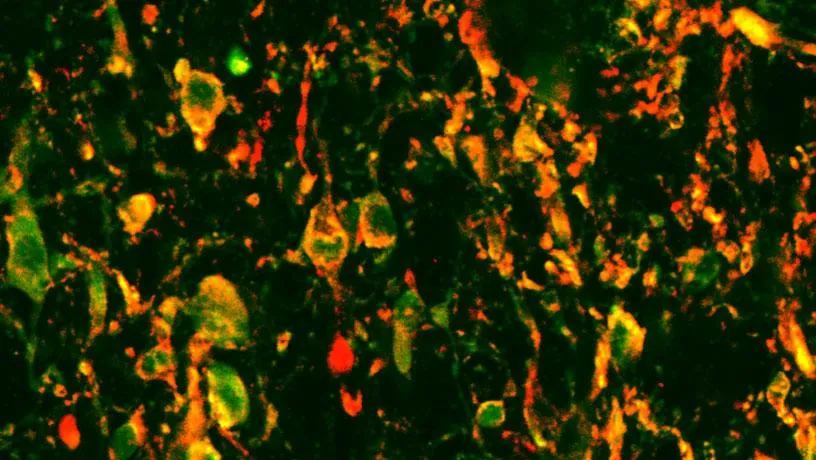
"A new study from Wang, who is developing innovative ways of selectively activating neural circuitry to enhance perception and cognition, demonstrates a major advance in understanding how the locus coeruleus (LC) modulates information processing in the thalamus. The principal site of norepinephrine production in the brain, the LC is thought to play an essential role in regulating brain states such as arousal, attention, and stress. Its malfunction has also been linked to anxiety, clinical depression, Alzheimer’s disease, and Parkinson's disease.
Wang’s group found that activating the LC improves the transmission of information about different features of sensory stimuli from the thalamus to the cerebral cortex, and subsequently perceptual performance in perceptual tasks. Through recordings and manipulations of a variety of neural circuits in the brain, they demonstrated this improvement is due to LC regulation of the interaction between two thalamic nuclei. Abnormal interplay between the two nuclei has recently been observed in several major clinical disorders, including Parkinson's disease and depression, and the Columbia Engineering findings provide insights into new treatments of these disorders. The paper was published today in Nature Neuroscience."